


A catering walkthrough is a structured, in-person venue inspection where event planners verify every logistical detail that affects food service before the event day. This site visit is the single most effective tool planners have to prevent costly surprises, align vendors, and protect the guest experience. Understanding why catering walkthroughs matter for planners means recognizing that the difference between a flawless event and a chaotic one is almost always decided weeks before guests arrive. Desertdine builds every event around this principle, treating the walkthrough as a non-negotiable planning milestone.
Why catering walkthroughs matter for planners
A catering walkthrough is not just a tour of the venue. It is a working inspection that forces every assumption about the space into the open. Involving caterers early in this process optimizes guest flow, staffing levels, and kitchen logistics, avoiding the reactive menu planning that derails so many events. The industry term for this process is a “pre-event site inspection,” and experienced planners treat it as the foundation of every run-of-show document.
The catering site visit benefits extend far beyond confirming that a kitchen exists. Planners who skip this step routinely discover problems on event day that a 90-minute walkthrough would have caught in advance. Standardized checklists prevent “venue-blindness” by forcing planners to verify assumptions and compare venues reliably before signing contracts. That discipline is what separates professional event execution from improvised problem-solving.

What happens during a catering walkthrough?
Every effective walkthrough covers a specific set of logistical checkpoints. Venue walkthroughs verify power availability, load-in routes, freight elevator capacities, and corridor widths. Each of these details directly affects how efficiently a catering team can set up, serve, and break down.
A thorough walkthrough covers:
- Access and load-in routes: Confirm where delivery vehicles can park, which entrances are available, and how far the kitchen is from the service area.
- Power and equipment: Check outlet locations, amperage availability, and whether the venue’s kitchen equipment matches the caterer’s needs.
- Freight and elevator access: Measure corridor widths and confirm lift sizes to avoid equipment that cannot reach the event floor.
- Staffing flow: Map where servers will stage, how they will move between the kitchen and tables, and where guests will queue.
- Contingency zones: Identify backup spaces for inclement weather, overflow seating, or equipment failures.
Physical constraints evaluated during walkthroughs help planners build realistic logistics schedules rather than optimistic ones. A caterer who knows the freight elevator holds only one rack at a time will plan load-in differently than one who assumes open access.
Pro Tip: Bring a printed checklist to every walkthrough. Relying on memory is unreliable. A written checklist lets you make direct venue comparisons and ensures you ask the hard questions every time, not just when something looks obviously wrong.
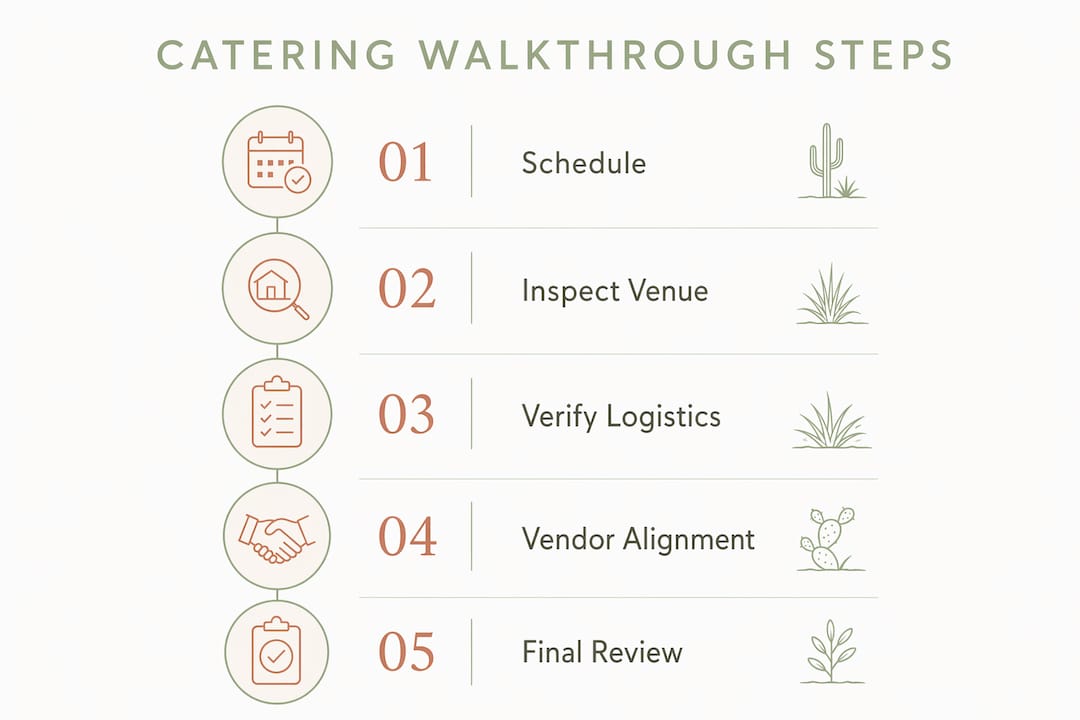
How walkthroughs improve coordination among vendors
Walkthroughs are the most underused alignment tool in event planning. When planners walk a venue with their caterer, AV team, and venue manager at the same time, every party hears the same information. That shared context eliminates the miscommunications that cause service delays and crowding on event day.
Here is how a structured walkthrough improves vendor coordination:
- Establish a shared timeline. Walking the space together lets vendors agree on load-in order, setup windows, and breakdown schedules before any conflict arises.
- Identify overlap points. Caterers and AV teams often need the same corridors and power sources. A walkthrough surfaces these conflicts early.
- Confirm last-minute layout changes. Venue furniture arrangements change. A final walkthrough catches those shifts before the caterer has already planned a service flow around the old layout.
- Align on contingency plans. Every vendor should know the backup plan for weather, power failure, or a late delivery. A walkthrough is the right moment to confirm those plans out loud.
- Reduce reactive decisions on event day. Final walkthroughs prevent cascading failures by giving caterers real-time information about changes made by other suppliers.
The importance of catering walkthroughs becomes clearest when you consider what happens without them. A caterer who has never seen the venue may plan a plated dinner service that requires 12 servers moving through a corridor that fits four. That error costs money, slows service, and frustrates guests.
Pro Tip: Treat the walkthrough as a vendor alignment session, not just a space inspection. Bring every key vendor, set a clear agenda, and document every decision made on site. That document becomes your event-day reference.
When should planners schedule catering walkthroughs?
Timing walkthroughs correctly is as important as conducting them at all. The industry standard calls for two distinct walkthroughs at different planning stages, each serving a different purpose.
| Walkthrough type | Timing | Primary purpose |
|---|---|---|
| Initial site inspection | At venue booking or shortly after | Assess logistics, confirm feasibility, inform menu planning |
| Pre-event final walkthrough | 24–48 hours before the event | Verify final layout, align vendors, catch last-minute changes |
| Mid-planning check (complex events) | 4–6 weeks before the event | Confirm progress, adjust for new vendor requirements |
Final walkthroughs conducted 24–48 hours before the event allow planners to solve problems while solutions are still available. A problem found the morning of an event has far fewer remedies than one found two days earlier.
Multi-day events and large-scale corporate functions benefit from a third walkthrough at the midpoint of the planning cycle. Accurate scheduling stems from on-site knowledge of travel distances, shared access points, and setup sequencing. No floor plan or venue brochure captures that detail as accurately as a physical visit.
Planners should integrate walkthrough findings directly into their run-of-show documents. Every confirmed detail, from load-in times to power outlet locations, belongs in the master timeline so the entire team operates from the same facts.
What goes wrong when planners skip walkthroughs?
Skipping a catering walkthrough is one of the most expensive shortcuts in event planning. The failures that result are predictable, and they almost always affect guests directly.
“The primary difference between catering success and failure is operational discipline. Checklists and walkthroughs, not informal processes, are what separate events that run smoothly from those that fall apart at service time.”
Common failures caused by inadequate site inspections include:
- Blocked load-in routes discovered on event day, forcing caterers to carry equipment through guest areas.
- Insufficient power supply that cannot support warming equipment, leading to food served at the wrong temperature.
- Misaligned service flow where servers and guests compete for the same narrow pathways.
- Unconfirmed vendor access times that cause setup to run late and compress the caterer’s preparation window.
- Menu items that cannot be executed in the available kitchen space, requiring last-minute substitutions.
A documented walkthrough checklist prevents these failures by forcing planners to verify assumptions before they become event-day crises. The checklist also creates an accountability record. If a venue manager confirmed that a freight elevator would be available and it is not, the planner has documentation to support a resolution.
Planners who institutionalize walkthroughs as a required step, not an optional one, report fewer service disruptions and stronger vendor relationships. The catering event brief that follows a thorough walkthrough is always more detailed and more accurate than one built from floor plans alone.
How to get the most out of every catering walkthrough
A walkthrough is only as valuable as the preparation behind it. Planners who arrive with a clear agenda and the right people in the room extract far more value than those who treat it as a casual tour.
Key practices that maximize every site visit:
- Bring the right people. Your caterer, venue coordinator, AV lead, and any vendor with a setup requirement should attend. Decisions made without them will need to be revisited.
- Use a standardized checklist. Expert operators confirm that standardized checklists are the foundation of consistent catering success. Customize yours for each event type, but keep the core questions the same.
- Document everything on site. Take photos of access points, power panels, and kitchen equipment. Written notes fade; photos do not.
- Ask about restrictions. Confirm noise curfews, vendor access windows, and any venue rules that affect catering setup or breakdown.
- Review the catering menu checklist before you go. Knowing what menu decisions depend on venue logistics helps you ask the right questions during the visit.
Food quality and guest experience are inseparable from early logistical planning. When the logistics framework is confirmed during a walkthrough, the caterer gains the creative freedom to design a menu and service style that fits the space perfectly.
Pro Tip: End every walkthrough with a five-minute debrief on site. Confirm the three most important decisions made during the visit, assign follow-up tasks, and set a deadline for written confirmation. That brief conversation prevents a week of back-and-forth emails.
Key Takeaways
Catering walkthroughs are the single planning step that most directly determines whether an event’s logistics and guest experience succeed or fail.
| Point | Details |
|---|---|
| Walkthroughs prevent event-day failures | In-person site visits catch logistical problems while solutions are still available. |
| Timing matters | Conduct an initial inspection at booking and a final walkthrough 24–48 hours before the event. |
| Vendor alignment is the core benefit | Walking the venue with all vendors at once eliminates miscommunications before they become service failures. |
| Checklists are non-negotiable | Standardized written checklists prevent venue-blindness and create accountability records. |
| Logistics enable creativity | Confirming the logistical framework early gives caterers the freedom to design better menus and service styles. |
What 15 years of walkthroughs taught me about event planning
I have walked hundreds of venues across California, and the pattern is always the same. The events that go wrong almost always had one thing in common: the planner trusted a floor plan instead of their own eyes. Floor plans do not show you that the “commercial kitchen” is a glorified break room, or that the freight elevator is shared with the hotel’s laundry service and books up by 7:00 AM.
The most memorable save I have seen came from a final walkthrough 36 hours before a 200-person corporate dinner. The AV team had added a large projection screen that cut directly into the caterer’s planned service lane. Because everyone was in the room together, the layout shifted in 20 minutes. Without that walkthrough, servers would have been squeezing past a screen all night, and guests would have noticed.
What I find most underappreciated is how walkthroughs unlock menu creativity. When a caterer knows the kitchen layout, the power capacity, and the service flow in advance, they stop designing menus around worst-case assumptions. They design around what is actually possible. That shift produces better food and a better guest experience. Planners who treat walkthroughs as a formality miss that entirely.
My advice is direct: make the walkthrough the first confirmed date on your planning calendar, not the last. The corporate event catering best practices that consistently produce excellent results all start with this step.
— James
Desertdine’s approach to walkthrough-driven catering
Desertdine treats every site visit as the foundation of a great event, not a box to check. From Palm Springs to Temecula, the Desertdine team conducts detailed venue inspections before finalizing any menu or staffing plan. That commitment means every logistical detail, from load-in routes to kitchen capacity, is confirmed before the event day.
Whether you are planning a wedding, a private dinner, or a corporate function, Desertdine’s planning process begins with a thorough walkthrough that aligns your vision with the realities of your venue. Explore full-service wedding catering or Temecula event catering to see how Desertdine’s walkthrough-driven approach delivers exceptional results. Ready to start planning? Book your event and let the Desertdine team handle every detail from the first site visit to the final course.
FAQ
What is a catering walkthrough?
A catering walkthrough is an in-person venue inspection where planners and caterers verify logistics, access points, kitchen capacity, and service flow before the event. It is also called a pre-event site inspection in the industry.
When should you do a final catering walkthrough?
Final walkthroughs are best conducted 24–48 hours before the event, when there is still time to solve problems before guests arrive.
Why should caterers attend venue walkthroughs?
Caterer input during walkthroughs improves menu flexibility, staffing decisions, and service flow planning. Caterers who see the space in advance design better menus and avoid reactive adjustments on event day.
What should a catering walkthrough checklist include?
A strong checklist covers load-in routes, power availability, kitchen equipment, freight elevator capacity, vendor access times, and contingency zones. Standardized checklists prevent oversight and create a consistent record across events.
What happens if you skip a catering walkthrough?
Planners who skip walkthroughs risk blocked load-in routes, insufficient power, misaligned service flows, and last-minute menu substitutions. These failures are predictable and almost always affect the guest experience directly.
Recommended
- Desert Dine Catering |Wedding Catering Walkthrough Visit: A Couples’ Guide• Palm Springs & Coachella Valley
- Desert Dine Catering |How Catering Proposals Work: A Planner’s Guide• Palm Springs & Coachella Valley
- Desert Dine Catering |Catering Tasting Event Best Practices for Planners• Palm Springs & Coachella Valley
- Desert Dine Catering |What Is a Catering Event Brief? A Planner’s Guide• Palm Springs & Coachella Valley


